
123456789怎样运算等于1? - abccsss 的回答 假定每个数字只能出现一次。

易通cmseasy免费的企业建站程序2.0 UTF-8 build 201000510 中文版
下载
易通(企业网站管理系统)是一款小巧,高效,人性化的企业建站程序.易通企业网站程序是国内首款免费提供模板的企业网站系统.§ 简约的界面及小巧的体积:后台菜单完全可以修改成自己最需要最高效的形式;大部分操作都集中在下拉列表框中,以节省更多版面来显示更有价值的数据;数据的显示以Javascript数组类型来输出,减少数据的传输量,加快传输速度。 § 灵活的模板标签及模
回复内容:
Mathematica代码较简洁
Det/@N@Range@9~Permutations~{9}~ArrayReshape~{9!,3,3}//Max
以上用Matlab暴力破解(枚举
max_det = 0;
init_perm = reshape(1:9, [3, 3]);
all_perms = perms(1:9);

for i = 1:size(all_perms, 1)
    matrix = all_perms(i, :);
    matrix = reshape(matrix, [3, 3]);
    det_value = det(matrix);

    if det_value > max_det
        max_det = det_value;
        init_perm = matrix;
    end

end
 list = Permutations[Range[9], {9}];
matrix = Partition[#, 3] & /@ list;
answer = Det /@ matrix;
m = Max[answer];
pos = Flatten[Position[answer, m]];
matrix[[#]] & /@ pos 贴个毫无技术含量暴力程度max的python版。。。
import itertools
import time

def max_matrix():
	begin = time.time()
	elements = [1, 2, 3, 4, 5, 6, 7, 8, 9]
	maxdet = 0
	maxmat = []
	for i in itertools.permutations(elements, 9):
		det = i[0] * i[4] * i[8] + i[1] * i[5] * i[6] + i[2] * i[3] * i[7] - i[2] * i[4] * i[6] - i[1] * i[3] * i[8] - i[0] * i[5] * i[7]
		if(det > maxdet):
			maxdet = det
			maxmat = []
			for j in range(0, 9):
				maxmat.append(i[j])
	print "|" + str(maxmat[0]) + " " + str(maxmat[1]) + " " + str(maxmat[2]) + "|"
	print "|" + str(maxmat[3]) + " " + str(maxmat[4]) + " " + str(maxmat[5]) + "| = " + str(maxdet)
	print "|" + str(maxmat[6]) + " " + str(maxmat[7]) + " " + str(maxmat[8]) + "|"
	end = time.time()
	print str(end - begin) + 's used.'

if __name__ == '__main__':
	max_matrix()
题目应该改成1 2 3 ...n^2组成n阶行列式的最大值。并求最优解的时间复杂度才有意思。
C++:#include
把yellow的答案重排一下可得9 4 2
3 8 6
5 1 7
很容易看出思路了。
1.所有数按大小在斜率为-1的对角线上依次排开。(即:987在一条对角线,654在一条,321在一条)很容易看出这是让正向数值最大的方法。
2.对于反向的对角线,排除主对角线之外的任意两个数之和相等,且乘积越大的,相应的主对角线元素越小。(也就是让三个乘积的最大值最小,然后最大的结果再和最小的数相配这样)
但是以上方法仅限于1~9的3x3矩阵,对于其它的矩阵不一定适用。
因为显然这种方法要求正向和负向都只有对角线(或平行于对角线),但是4x4的行列式就开始有拐弯了。。。
然后,我感觉还有三个漏洞,一是贪心法不一定保证正向最大,也不一定保证反向最小,更不一定保证正反向之差最大。(不一定都是漏洞,可能有的是恒成立的)
但是我感觉对3x3的非负矩阵来说,贪心在多数情况下是可以拿到最大值的。
PS:试了很多组数,都是这个解,然后又试了一组[1 2 3 4 5 6 7 8 100],显然答案发生了变化,因为100的权值比8和7大太多,所以负向的时候直接就把2和1给了100。那么这也就证明了贪心法确实有时候得不到最大值。 前面已经有了python,c和MMA的代码了,我来一发matlab的吧
p=perms(1:9);
[n,~]=size(p);
z=zeros(n,1);
for i=1:n
    z(i)=det(reshape(p(i,:),3,3));
end
max(z)
id=find(z==max(z));
for i=1:length(id)
    disp(reshape(p(id(i),:),3,3));
end
对于三阶的穷举,可以不用det函数会比较简单:p = reshape(perms(1:9),'',3,3);
M = max(sum(prod(p,2),3)-sum(prod(p,3),2));
话题的语言还少个Mathematica,就我来吧直接9!个结果存下来刚正面,0优化
Det[Partition[#, 3]] & /@ Permutations[Range[9]] // Max

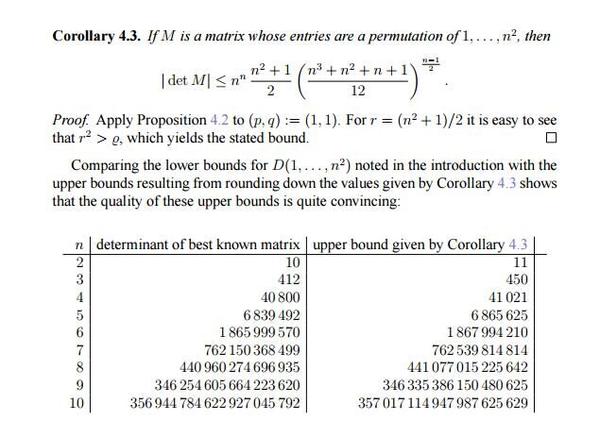
412