
给定一个由数字组成的字符串,任务是将这些给定的数字转换为单词。
比如我们有一个输入“361”;那么输出应该是单词形式,即“三百六十一”。对于解决这个问题,我们需要记住数字和它所在的位置,比如个位、十位、千位等。
代码只支持0到9999的4位数字。所以输入应该在0到9999之间。
让我们考虑1,111,那么位置将会是这样:

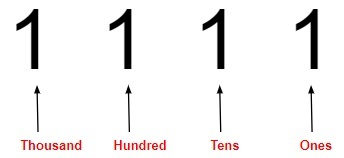
示例
Input: “1234”
Output: one thousand two hundred thirty four
Input: “7777”
Output: seven thousand seven hundred seventy seven
我们将使用的方法来解决给定的问题 −
- 将输入作为字符串。
- 为不同的值创建数组。
- 根据输入的长度检查,决定我们将显示输出到哪些位置。
- 根据位置显示输出。
算法
Start
Step 1 → In function convert(char *num)
Declare and initialize int len = strlen(num)
If len == 0 then,
fprintf(stderr, "empty string")
Return
End If
If len > 4 then,
fprintf(stderr, "Length more than 4 is not supported
")
Return
End If
Declare and initialize a char *single_digit[] = { "zero", "one", "two","three", "four","five","six", "seven", "eight", "nine"}
Declare and initialize a char *tens_place[] = {"", "ten", "eleven", "twelve","thirteen", "fourteen","fifteen", "sixteen","seventeen", "eighteen", "nineteen"}
Declare and Initialize a char *tens_multiple[] = {"", "", "twenty", "thirty", "forty", "fifty","sixty", "seventy", "eighty", "ninety"}
Declare and initialize char *tens_power[] = {"hundred", "thousand"}
Print num
If len == 1 then,
Print single_digit[*num - '0']
Return
End If
While *num != '\0
If len >= 3
If *num -'0' != 0
Print single_digit[*num - '0']
Print tens_power[len-3]
End If
Decrement len by 1
End If
Else
If *num == '1' then,
Set sum = *num - '0' + *(num + 1)- '0'
Print tens_place[sum]
Return
End If
Else If *num == '2' && *(num + 1) == '0' then,
Print “twenty”
Return
End else If
Else
Set i = *num - '0'
Print i? tens_multiple[i]: ""
Increment num by 1
If *num != '0' then,
Print single_digit[*num - '0']
End If
End Else
Increment num by 1
End Else
End while
Step 2 → In function main()
Call function convert("9132")
Stop
Example
#include#include #include //function to print the given number in words void convert(char *num) { int len = strlen(num); // cases if (len == 0) { fprintf(stderr, "empty string "); return; } if (len > 4) { fprintf(stderr, "Length more than 4 is not supported
"); return; } // the first string wont be used. char *single_digit[] = { "zero", "one", "two", "three", "four","five", "six", "seven", "eight", "nine"}; // The first string is not used, it is to make // array indexing simple char *tens_place[] = {"", "ten", "eleven", "twelve", "thirteen", "fourteen", "fifteen", "sixteen", "seventeen", "eighteen", "nineteen"}; // The first two string are not used, they are to make // array indexing simple char *tens_multiple[] = {"", "", "twenty", "thirty", "forty", "fifty","sixty", "seventy", "eighty", "ninety"}; char *tens_power[] = {"hundred", "thousand"}; // Used for debugging purpose only printf("
%s: ", num); // For single digit number if (len == 1) { printf("%s
", single_digit[*num - '0']); return; } // Iterate while num is not '\0' while (*num != '\0') { // Code path for first 2 digits if (len >= 3) { if (*num -'0' != 0) { printf("%s ", single_digit[*num - '0']); printf("%s ", tens_power[len-3]); // here len can be 3 or 4 } --len; } // Code path for last 2 digits else { // Need to explicitly handle 10-19. Sum of the two digits is //used as index of "tens_place" array of strings if (*num == '1') { int sum = *num - '0' + *(num + 1)- '0'; printf("%s
", tens_place[sum]); return; } // Need to explicitely handle 20 else if (*num == '2' && *(num + 1) == '0') { printf("twenty
"); return; } // Rest of the two digit numbers i.e., 21 to 99 else { int i = *num - '0'; printf("%s ", i? tens_multiple[i]: ""); ++num; if (*num != '0') printf("%s ", single_digit[*num - '0']); } } ++num; } } int main() { convert("9132"); return 0; }
输出
nine thousand one hundred thirty two